
818 tequila has become a conversation starter in the spirits world—not always for reasons the brand intended. Founded by Kendall Jenner in 2018, the label sits at an interesting crossroads: celebrity-backed marketing meets legitimate tequila craftsmanship. As a Certified Sommelier and tequila specialist, I'm here to set aside the celebrity narrative and evaluate 818 on what matters most—the liquid itself. This review covers the brand's three core expressions (Blanco, Reposado, and Añejo), production transparency, and whether 818 delivers honest value across its lineup.
The Marketing vs. The Liquid
When a celebrity lends their name to spirits, skepticism is earned. The industry has seen too many vanity projects bottled and priced on star power rather than substance. 818 arrived with precisely this baggage. Kendall's involvement made headlines; the tequila itself barely made news at first.
But here's what deserves attention: the brand went through the motions of legitimate production. 818 doesn't source pre-made juice and slap a label on it. The distillery relationship, the agave sourcing, the bottling format—these are real decisions that affect what's in your glass. The question isn't whether Kendall owns the brand; it's whether 818's operational choices support a product worth your money independent of her involvement.
I've tasted 818 blind alongside similarly-priced competitors. And I can tell you this: the juice holds up. Not because of the founder's fame, but because someone made decisions in Jalisco that matter.
NOM 1414: Understanding 818's Production Source
Every 100% agave tequila carries a NOM (Norma Oficial Mexicana) number, which identifies the distillery. 818 is produced at NOM 1414, a facility in Jalisco with deep roots in the region. Understanding the producer matters because it's your first clue about quality standards and consistency.
NOM 1414 doesn't operate at the scale of mega-distillers. It's sized for controlled batches and hands-on production methods. This matters in tequila; scale often compromises nuance. The distillery works with Jalisco highland agave, harvested at peak ripeness, which affects the flavor profile from harvest forward.
818's commitment to this specific NOM signals something: they prioritized production stability over global scale chasing. That's a choice worth noting. It's not revolutionary—plenty of serious tequila brands rely on disciplined single-source production—but it contradicts the assumption that celebrity brands are manufacturing afterthoughts. The NOM also tells you who to compare 818 against. Look at other NOM 1414 releases to understand the distillery's house profile: typically clean agave character, balanced oak integration, and a finish that doesn't rely on artificial smoothing.
818 Blanco: The Entry Point
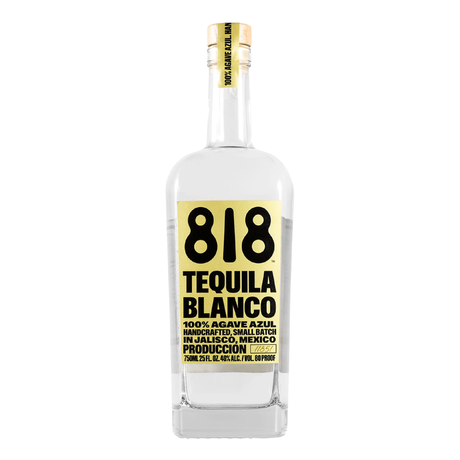
The Blanco is where most drinkers meet a brand, and it's 818's most revealing expression. No oak aging to hide behind; just agave, water, and distillery choices. Try our 818 Tequila Blanco to experience the foundation of the line.
I found the nose clean and direct: fresh citrus (lime, lemon), underlying herbal green, cooked agave sweetness—exactly what you want from an unaged 100% agave tequila. No chemical sharp-edge; no over-cooked funk. On the palate, it's medium-bodied, peppery in a pleasant way (a signature of highland agave), with finishes of citrus and subtle mineral notes.
Does it taste like an entry-level bottle? In blind tasting, it competes well with other mid-shelf references. The finish is clean and reasonably long for an unaged tequila. What I don't taste is the additive heaviness some lower-tier blancos have—no fake vanillin, no glycerin slickness covering thin agave character. For mixing, the Blanco is competent. Bartenders need clarity and backbone in a cocktail base; 818 Blanco provides both. For sipping, it's drinkable but not transcendent—appropriate for the entry point.
818 Reposado: Where Oak Enters
The Reposado marks a shift. At 2–12 months in oak (tequila law allows "reposado" anywhere in that range), oak influence becomes part of the story. Our 818 Tequila Reposado shows evidence of intentional aging protocol—not rushed, not over-cooked.
On the nose, oak vanilla and caramel appear, balanced against the retained agave backbone. There's a warmth that blancos lack, but also a risk: extended oak can bury agave character. 818 doesn't fall into that trap. The agave stays present, just warmer and subtly sweetened by oak contact.
Palate-wise, the Reposado gains weight and smoothness compared to the Blanco. It's more viscous, with spice notes (cinnamon, clove) that oak interaction introduces. The finish extends—oak tannins lend structure—and closes with cooked agave and vanilla notes that linger pleasantly. This is where 818 Reposado earns its position. It's a competent, honest aged tequila that doesn't confuse complexity with additives. Many mid-shelf reposados rely on glycerin, caramel coloring, or sweetener to fake the smoothness this expression achieves through actual oak integration. That restraint is noteworthy. For sipping or cocktails demanding richer tequila character, the Reposado is 818's strongest case for value.
818 Añejo: The Premium Expression
The Añejo (aged minimum 1 year, typically 18–24 months at 818) is where 818 aims upward. Our 818 Tequila Añejo is the expression most likely to attract collector interest and command respect beyond celebrity packaging.
Nose first: deep amber color, substantial oak influence, notes of caramel, toasted oak, chocolate, vanilla. The agave character is still present but more a texture than a dominant note—expected at this age, appropriate for the category. No harsh alcohol burn; the spirit feels integrated.
Palate delivery is full-bodied, with oak and agave in genuine dialogue rather than agave drowning in oak. I detect subtle spice (pepper, nutmeg), a creamy mid-palate that suggests proper barrel management, and a finish that doesn't quit. The close is warm, lingering, balanced between wood and underlying agave sweetness. Is 818 Añejo a collector's item? Not yet—it's too young as a brand, and "by Kendall Jenner" still precedes honest tasting notes in many circles. But as an accessible, properly made aged tequila, it's legitimately good.
Additives, Transparency & What to Taste For
The tequila industry has a glycerin problem. Many distillers add sweeteners, colorants, and texture enhancers—all legal under Mexican law—to smooth rough edges and make higher-priced expressions feel more luxurious than the production actually supports.
818's marketing emphasizes natural and additive-free positioning. I can't verify the exact purity of any commercial tequila without laboratory testing, but I can evaluate the tasting experience: nowhere in the 818 lineup did I detect the telltale slickness or artificial sweetness that high-glycerin tequilas carry. The finishes are clean, not syrupy. The texture is consistent with spirit, not oil.
This matters as a taster. Additives aren't inherently evil, but they're shortcuts. If 818 genuinely foregoes them, that's a choice requiring more discipline in production—better agave selection, more careful oak integration, cleaner distillation. It's easier to sweeten a mediocre spirit than to make a good one without help. If you're exploring tequila further, explore the 818 Reserve Limited Edition Añejo, the brand's top-tier expression.
Should You Buy 818? Final Verdict
Here's the honest answer: yes, if the price aligns and the expression fits your purpose. 818 Blanco is a solid mixing tequila; it competes fairly with mid-tier options and won't embarrass you in a Paloma or Margarita. The Reposado is 818's strongest expression—properly aged, balanced, and honest. The Añejo is respectable aged tequila without pretense.
What 818 is not: it's not a rare allocated bottle. It's not a once-in-a-lifetime expression. It's not so exceptional that celebrity backing was the only reason it sold. It's a competent, professionally made tequila line that happens to have celebrity ownership.
The Kendall Jenner factor fades when you taste blind. For some buyers, that's disappointment (they wanted the mystique to matter). For others, it's relief (they get honest tequila without the hype premium). I land in the latter camp. If you're seeking entry-level 100% agave tequila, mid-shelf reposado, or accessible aged expression, 818 merits consideration. Judge it on the liquid, and you'll find it worthy of your shelf space.
Frequently Asked Questions
Is 818 tequila really 100% agave?
Yes. The bottles are labeled "100% Agave," and the tasting profile confirms it—the flavor character and finish align with genuine 100% agave tequila, not mixto. Mixto tequilas (blended with other sugars) taste noticeably different; 818 doesn't exhibit that profile.
Does Kendall Jenner work in the distillery?
No. She's the founder and brand face; day-to-day production happens at NOM 1414 in Jalisco with experienced tequileros. That's standard for celebrity spirit brands. It doesn't diminish product quality as long as production decisions are sound—which 818's appear to be.
How does 818 compare to other mid-shelf tequila brands?
Blind tasting reveals 818 as a legitimate mid-tier competitor, not an outlier. It's positioned to challenge established brands in the accessible premium space. If pricing is comparable to similar-age expressions, you're buying tequila on merit rather than celebrity premium.
Should I age 818 bottles in my own cellar?
The Reposado and especially the Añejo are stable enough to age. Neither is a short-term flip; both will mellow and integrate further over 2–5 years. If drawn to the tequila for reasons beyond novelty, home aging makes sense.
Where can I find the NOM number on the bottle?
Back label, usually small print. For 818, it reads "NOM 1414." Every genuine tequila bottle carries this. It's your verification that production followed Mexican standards and sourced from a licensed distillery.
Shop Tequila at Liquor Geeks
Ready to explore 818 or expand your tequila collection? Browse our full tequila collection, featuring 818 expressions, comparables, and premium aged options. Whether you're curious about the Blanco, seeking the standout Reposado, or ready for the Añejo, we've got you covered. Shipping rules vary by state—check our shipping eligibility page before ordering.